

















The Basic Idea: Clearing the Board
Arrow Out presents you with a grid filled with arrows pointing in different directions—up, down, left, or right. Your only action is to click an arrow. When you do, that arrow slides off the board in the direction it's pointing, pushing any arrows in its path along with it. The goal is to clear every arrow from the grid. It sounds simple, but the order in which you click is everything. Click the wrong one first, and you might trap another arrow with no path to exit.
Understanding Movement and Blocking
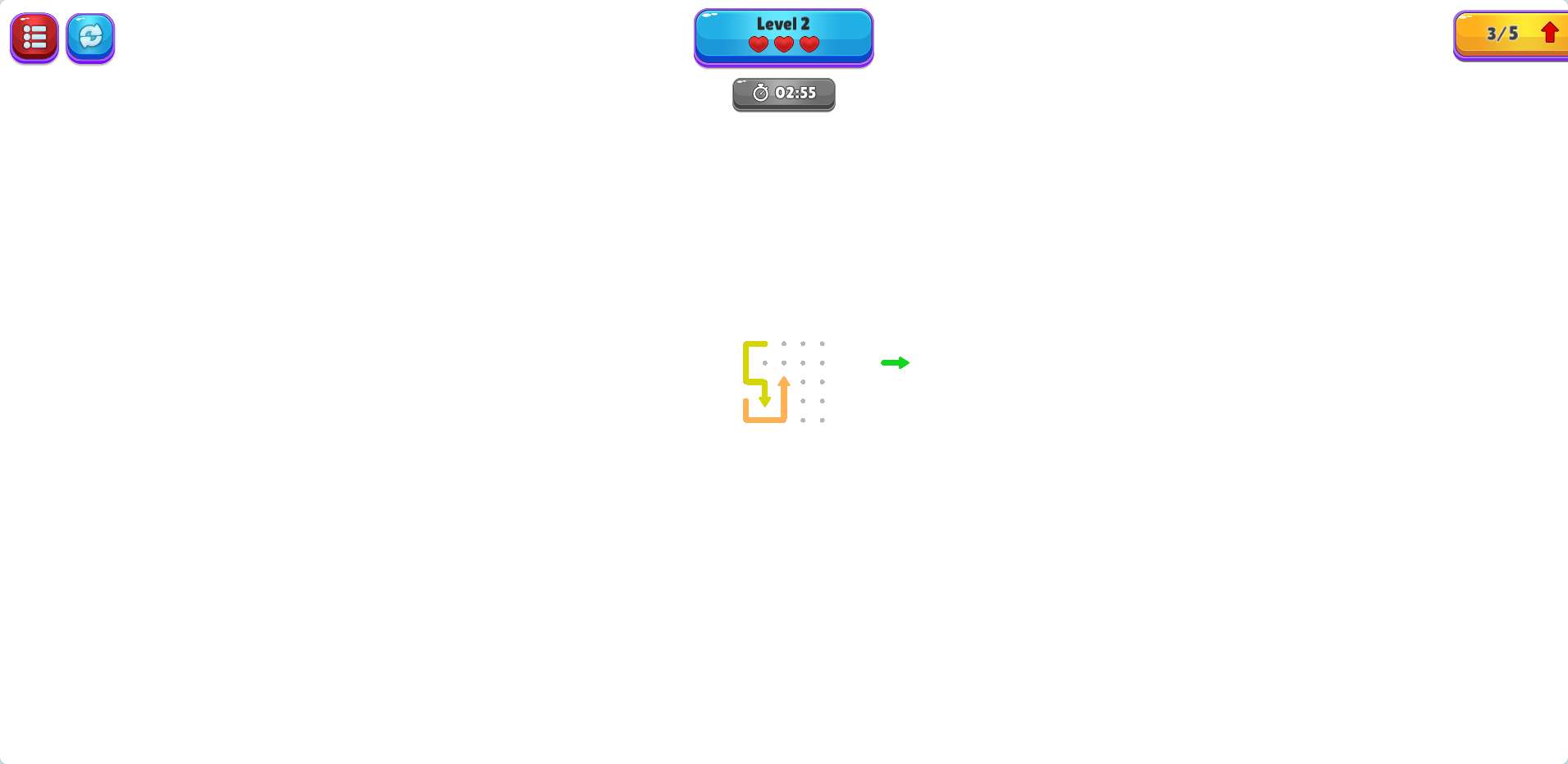
The crucial thing to visualize is the slide path. An arrow pointing right will travel across its entire row until it hits the edge of the board. If another arrow is in that row, it will be pushed ahead. This can be useful for repositioning pieces, but it can also cause problems. If an up-pointing arrow is directly above a down-pointing arrow, clicking either one will cause them to collide and block each other's exit. The puzzle often becomes a spatial logic problem: you need to create clear lanes by removing specific arrows first.
A Practical Strategy for Early Levels
Start by scanning the board for "free" arrows—those pointing directly toward an open edge with nothing in their way. Remove those first. Next, look for arrows that are blocking others. Sometimes, you need to click a blocking arrow to move it out of the way, even if it doesn't exit immediately, just to free up the path for the piece behind it. A good habit is to mentally trace the exit path for each arrow before clicking. Ask yourself: "If I click this now, what gets moved, and does anything get stuck?"
Where the Challenge Really Kicks In
After the first few introductory levels, Arrow Out introduces more crowded boards and clever configurations. The game stops being about single exits and starts presenting interlocking dependencies. You'll encounter setups where three or four arrows are cyclically blocking each other. The solution usually involves using one arrow to push another into a correct position before finally removing a key piece. This is where the game transitions from a casual swipe game to a genuine brain teaser.
An Editorial Note on Its Appeal and Limits
What stands out about Arrow Out is its purity. There's no timer, no score, no stars—just the satisfaction of figuring out the sequence. The clean visuals and single-action mechanic make it incredibly easy to pick up. For players who enjoy spatial reasoning games like parking puzzles or pipe connectors, this will feel familiar and engaging. However, the core interaction never changes. If you're looking for narrative, power-ups, or evolving mechanics, you won't find them here. The enjoyment is entirely in the logical "aha" moment of each solution. It's the kind of game perfect for short, focused sessions when you want to untangle a neat puzzle.
Common Pitfalls to Avoid
The most frequent mistake is acting too quickly. Because the click mechanic is so simple, it's tempting to just start clicking to see what happens. This almost always leads to a dead end. Another trap is focusing only on getting one specific arrow out, ignoring how that action reshapes the entire board. If you get stuck, don't just reset randomly. Take a step back and look at the board anew. Often, the solution involves removing what seems like an unimportant arrow on the opposite side first to create a domino effect. Remember, every move is permanent within a level, so each click needs intention.
One Quick Tip
New players usually do better when they slow down a little and pay attention to repeating patterns instead of reacting too quickly.