

















Game Introduction
A fun math enlightenment game tailored for kids that cleverly combines basic arithmetic learning with dice elements. Here, children don’t have to engage in tedious rote memorization; instead, they can easily practice and improve their addition, subtraction, multiplication and division skills through interesting dice interactions. This game balances entertainment and knowledge, allowing kids to naturally consolidate their arithmetic foundations in an immersive gaming experience, truly realizing "learning through play and having fun while learning".
Game Features
1. Fun Arithmetic Training Driven by Dice
Abandoning the tedious traditional arithmetic drill mode, it deeply integrates basic addition, subtraction, multiplication, and division operations with dice rolling and point combination. Every time a child rolls the dice, a random arithmetic problem is triggered—such as calculating the sum, difference, or product based on the dice points. It not only retains the randomness and freshness of dice games but also allows children to repeatedly consolidate their computing skills through fun interactions.
2. Progressive Difficulty Matching Children's Cognition
Targeting the arithmetic levels of children of different ages, a staged challenge mode is set up. Low-level levels focus on addition and subtraction within 10, which can be completed with only 1-2 dice; intermediate levels expand to mixed operations within 20, increasing the number of dice rolls and combination logic; advanced levels cover the basics of multiplication and division, with complex formulas designed through the point linkage of multiple dice. The difficulty progresses step by step, fitting the cognitive growth curve of children.
3. Instant Feedback and Positive Incentive Mechanism
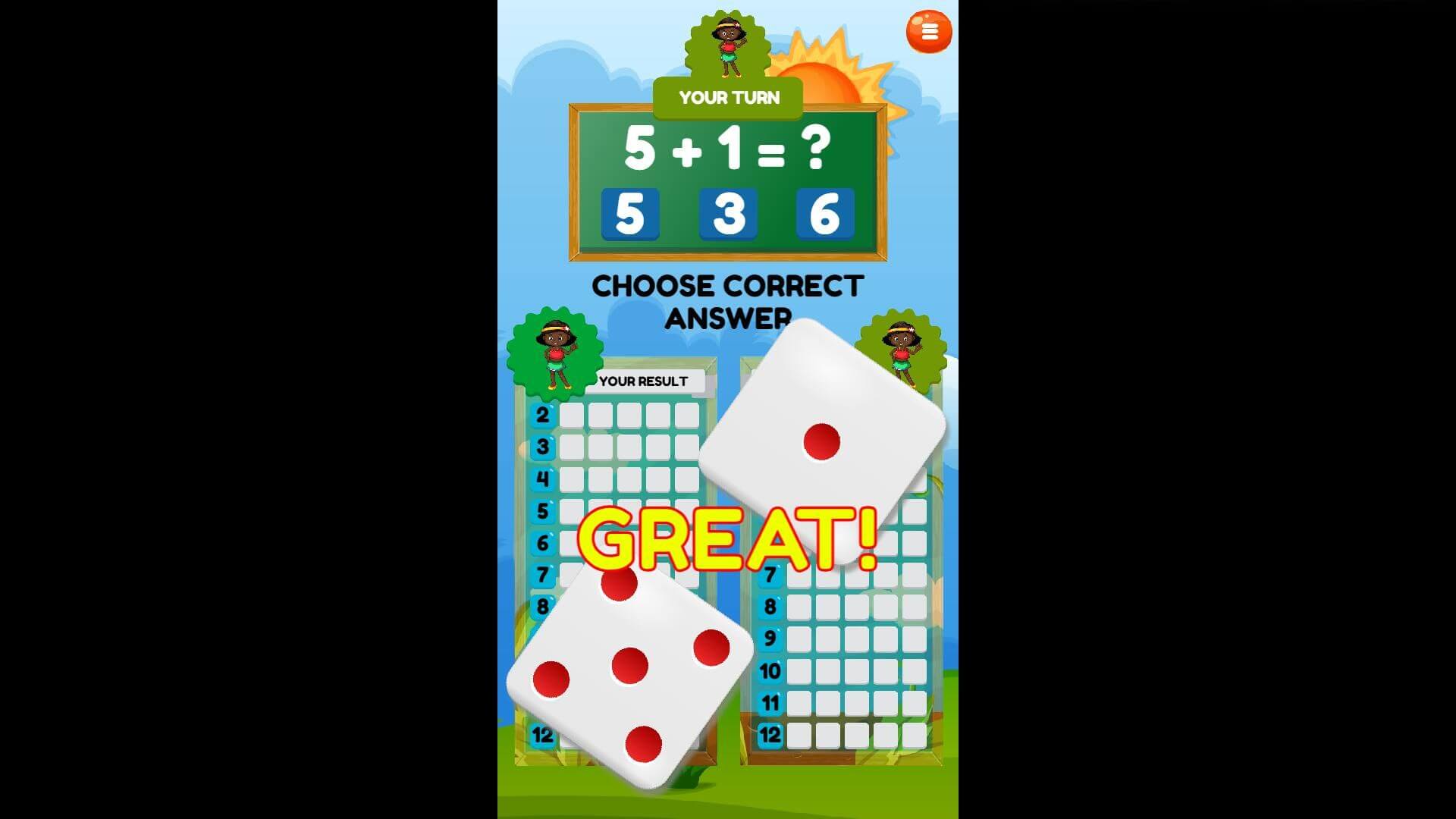
Visual feedback is provided immediately after each question is completed: cute dice animations and voice encouragement are triggered when the answer is correct, and gold coins can be accumulated to exchange for cartoon dice skins; gentle problem-solving hints instead of direct corrections are given for wrong answers to protect children's learning self-confidence. Meanwhile, achievement badges such as "Arithmetic Prodigy" and "Dice Calculation Master" are set to stimulate the motivation for continuous challenges.
4. Situational Immersive Learning Scenarios
Childlike scenarios such as forest adventures and dessert shop management are integrated, and arithmetic tasks are packaged into fun missions: for example, helping small animals distribute food according to dice points (addition), pricing and giving change for desserts (subtraction/multiplication). It allows children to understand the practical application of mathematics through role-playing, bid farewell to mechanical memory, and achieve the educational goal of "learning through play".
5. Interactive Gameplay for Parent-Child Collaboration
It supports a two-player mode, where parents can team up with their children to pass levels: one is responsible for rolling the dice, the other for calculating the answer, or a parent-child PK match can be launched to compete for computing speed and accuracy. It not only enhances parent-child companionship but also strengthens children's arithmetic application ability through collaboration and competition, while facilitating parents to keep abreast of their children's knowledge mastery in real time.
6. Lightweight and Stress-Free Learning Experience
The interface adopts a high-saturation cartoon style, with cute and easy-to-understand dice shapes. The operation only requires clicking and dragging, which is easy for young children to master; the duration of a single level is controlled within 5 minutes to avoid children's attention fatigue. Arithmetic practice can be completed in fragmented time, adapting to the flexible learning needs of family and after-school scenarios.
Gameplay and Controls
1. Level Selection & Launch: Click on the level corresponding to the difficulty or scenario to enter the game.
2. Dice Rolling: Tap the "Roll" button on the screen to get random dice points.
3. Answer Submission: Complete arithmetic operations based on the dice points, enter the answer via the number keys and submit it.
4. Feedback & Level Progression: Correct answers earn rewards (unlock dice skins/achievement badges); wrong answers will receive problem-solving hints for a retry; after passing a level, you will automatically enter the next one.
Game Guide
With "learning through play" at its core, *Dice Math Kids Game* helps children solidify their arithmetic skills while having fun. The key lies in leveraging dice mechanics and stage-specific rules to find the right approach. This guide covers tips for all stages, enabling kids to clear levels efficiently while maintaining their interest.
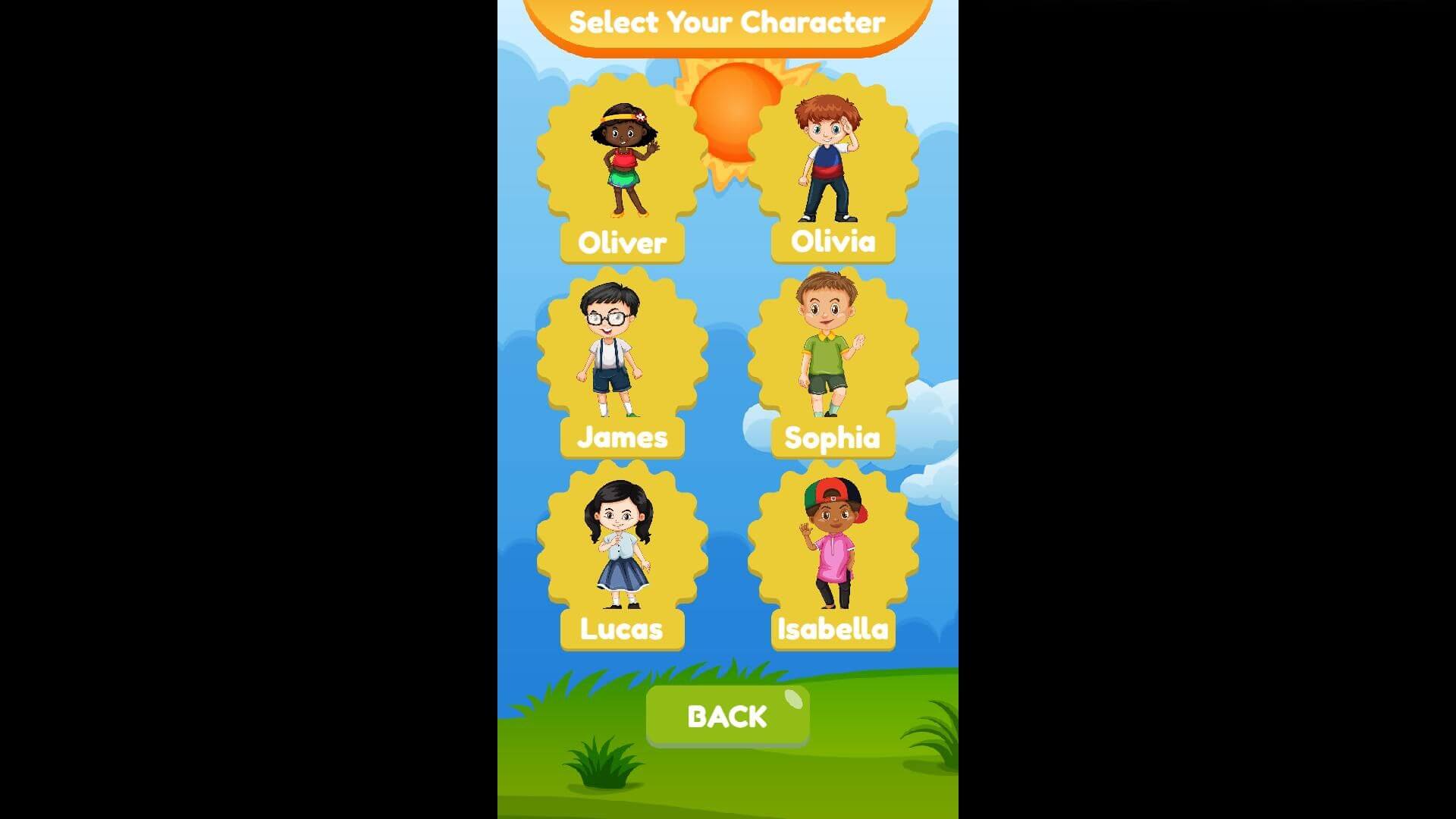
Beginner Levels (Operations within 10): Focus on Basic Response Speed
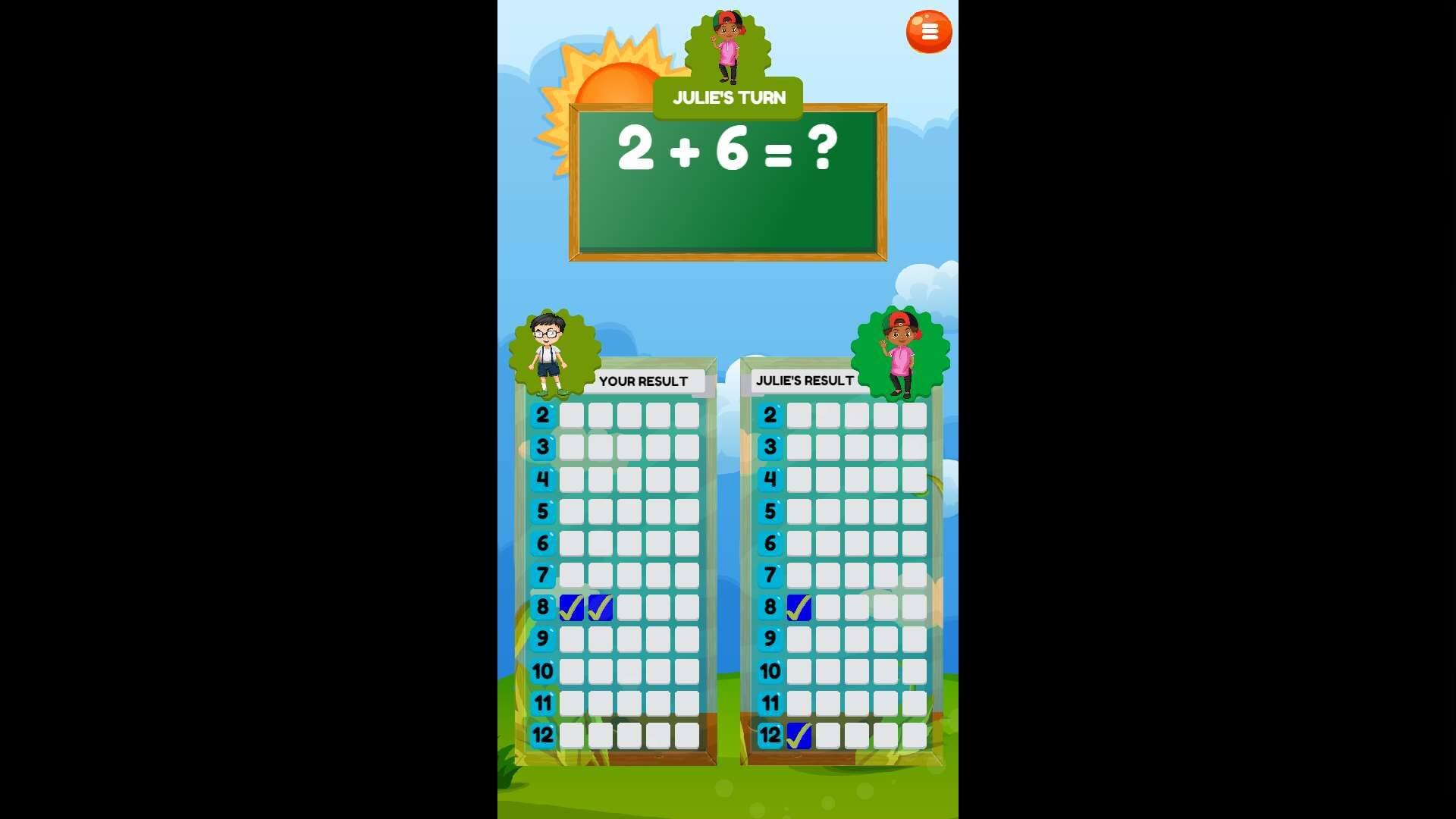
After rolling the dice, don’t rush to calculate—first observe the number combinations. If you roll a 5 and a 3, use the "10-combination method" (linking 5+3=8) instead of counting one by one for faster results. For subtraction problems (e.g., dice rolls of 6 and 2), guide children to use the "countdown method" or "decomposition method": 6-2 can be split into 6-1-1 to reduce errors. The priority at this stage is to practice speed; answering 5 consecutive questions correctly unlocks basic dice skins, building a sense of accomplishment.
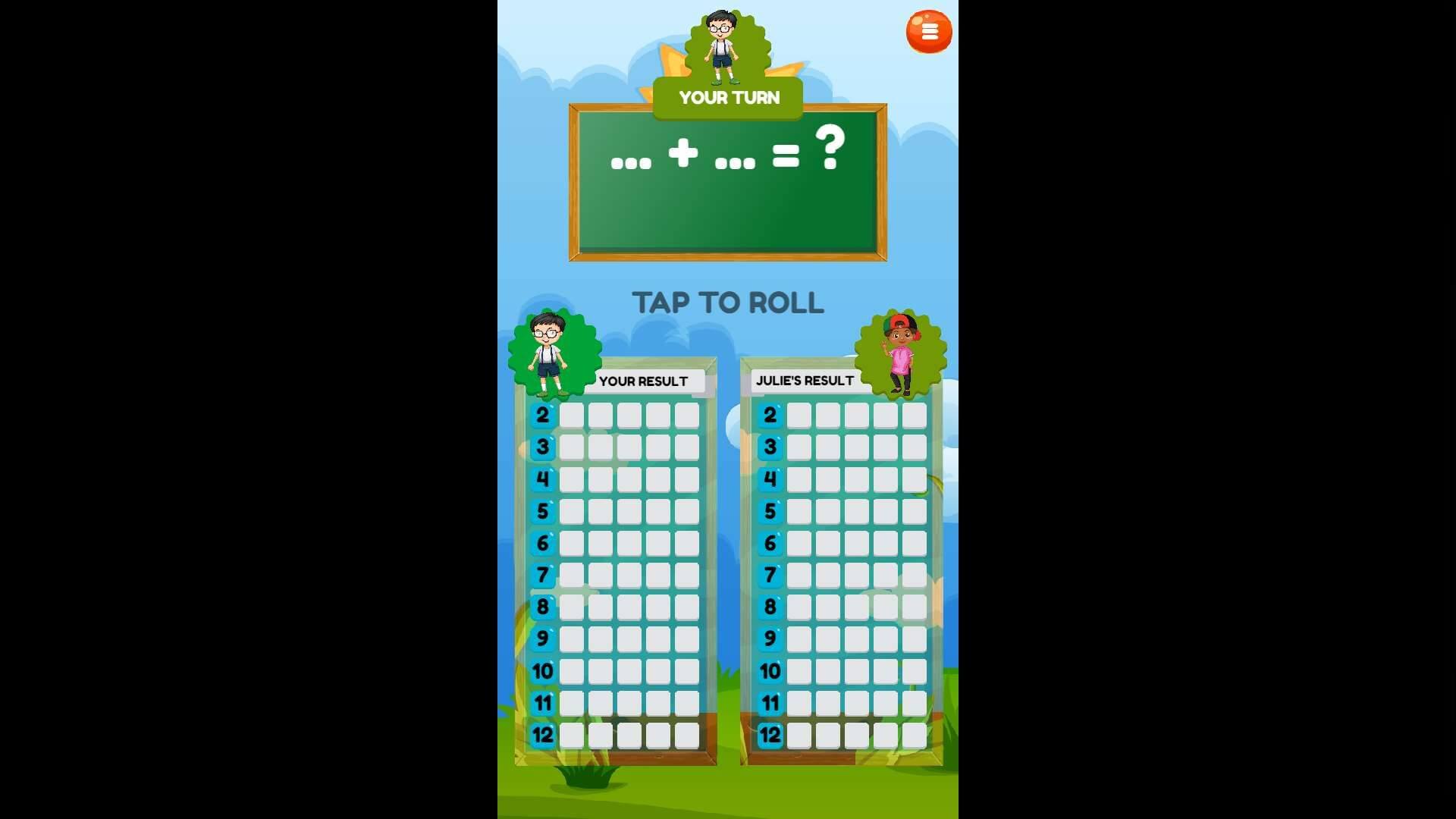
Intermediate Levels (Mixed Operations within 20): Master Priority Skills
When rolling multiple dice, first mark combinations that add up to round numbers. For example, with rolls of 3, 7, and 5, calculate 3+7=10 first, then add 5 for greater efficiency. For questions involving multiplication and division, follow dice operation logic by prioritizing combinations that yield integers or are divisible. For instance, with rolls of 4, 2, and 3, compute 4÷2=2 first, then multiply by 3 to get 6, minimizing calculation steps. If stuck, use the hint function but encourage kids to first figure out the hinted operation logic before solving the problem.
Advanced Levels (Intro to Multiplication & Division): Use Strategic Decomposition
For complex multi-dice rolls, break down the target operation first. With rolls of 2, 3, and 6, if multiplication is required, combine 2×3=6 and pair it with the remaining number. For division, prioritize using 1 or small numbers as divisors to increase the chance of even division. After clearing a level, review mistakes and highlight confusing combinations (e.g., the difference between 3×6 and 2×9) to reinforce memory.
Tips for Earning Rewards
To unlock rare dice skins, maintain a winning streak by clearing levels consecutively and keep each session under 5 minutes to avoid attention fatigue. Badges like "Arithmetic Prodigy" require focusing on specific operations—for example, practice addition in the forest adventure scenario for targeted progress.
General Tips
Use short breaks for practice, completing 2–3 levels daily to stay sharp.
Have kids predict possible dice combinations before rolling to build number sense.
Encourage error analysis instead of hasty retries to protect learning confidence.
With these strategies, children can effortlessly boost their arithmetic skills as they roll the dice.