

















What Is Scary Match 3?
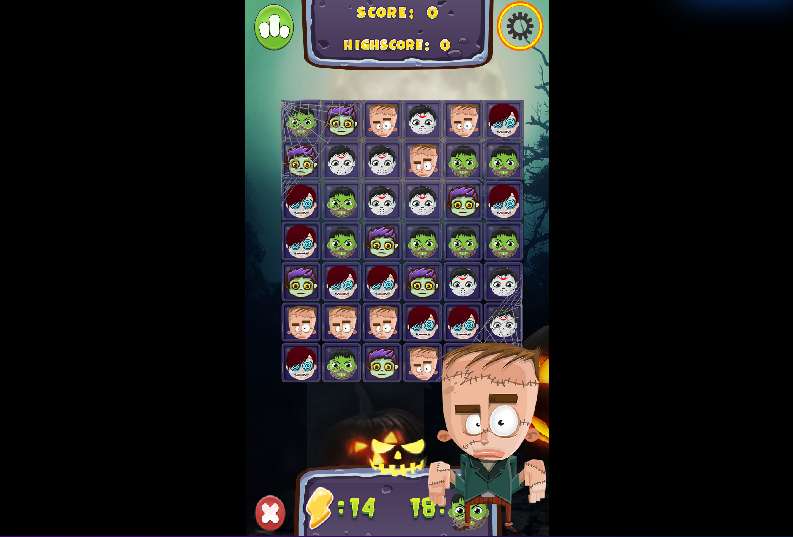
Scary Match 3 takes the usual match-3 formula and gives it a Halloween makeover. Instead of jewels or candy, you’re lining up grinning, frowning, and goofy monster faces. The core loop is the same as any tile-matching game—swap tiles to make three or more in a row—but the visual theme gives it a playful, spooky identity. It’s a browser game, so you can jump in without downloads, and the difficulty ramps up quickly enough to keep you paying attention.
How the Game Works
You start each level with a board full of different monster face tiles. Your goal is to remove them by matching at least three identical faces. When you make a match, those tiles disappear and new ones fall from the top. Points are awarded for each match, and combos happen when tiles fall into place and create new matches automatically. The level is cleared once you hit a target score or remove a certain number of tiles, depending on the level’s rules. If you run out of moves (on levels with a move limit) or let the board fill up too much, you lose.
Controls are simple—click a tile, then click an adjacent tile to swap them. You can only swap if the swap creates a match of three or more. No drag-and-drop here, just point-and-click.
Tips for New Players
Don’t just make any match you see. Take a moment to scan the board for matches that will trigger cascades—those chain reactions where matched tiles cause new tiles to fall and match again. Cascades are the fastest way to rack up points and clear a crowded board. A single swap that creates two matches at once (for example, swapping a tile that completes both a horizontal and vertical line) is almost always better than a simple three-in-a-row.
Another mistake beginners make is ignoring the top of the board. Tiles near the top can be swapped to drop far-down matches, but it’s often more effective to work from the bottom. Matching tiles at the bottom can cause the whole column above to collapse, which might create multiple matches at once. This is especially useful when you’re low on moves.
If a level has a move limit, plan a couple of moves ahead. Ask yourself: “If I make this swap, what new tiles drop in? Could that set up a match for my next move?” This kind of forward thinking separates casual playing from consistent clearing.
When the Game Feels Repetitive (And Why That’s Okay)
Let’s be honest—match-3 games are repetitive by design. Scary Match 3 doesn’t reinvent the wheel, and after ten or fifteen levels you might feel like you’ve seen most of what it has to offer. But the game’s charm comes from its gradual difficulty increases. Early levels are almost too easy, and then suddenly you’ll hit a level where the board is cramped and the target score feels unfair. That’s when the game actually gets interesting. It forces you to think about tile placement and move efficiency, not just tap randomly.
Players who enjoy a casual puzzle that doesn’t demand long sessions will find this a good fit. It’s the kind of game you play during a break or while waiting for something. If you’re looking for deep strategy or a storyline, this isn’t it. But for what it is—a themed match-3 with a bit of personality—it does the job.
Common Pitfalls to Avoid
- Wasting moves on small matches: If you have 20 moves and need 2000 points, a three-tile match that scores 20 points won’t cut it. Go for larger matches or cascades whenever possible.
- Forgetting to check all possible swaps: Sometimes the best move isn’t obvious. Quickly scan rows and columns to see if a swap in an unexpected spot creates a four- or five-tile match.
- Ignoring the timer/move counter: On move-limited levels, every swap counts. Resist the urge to “just see what happens.” Have a reason for every swap.
With a little patience and attention, you’ll be clearing boards and racking up combos in no time. The monsters are scary-looking, sure, but they’re not that tough once you get the hang of it.