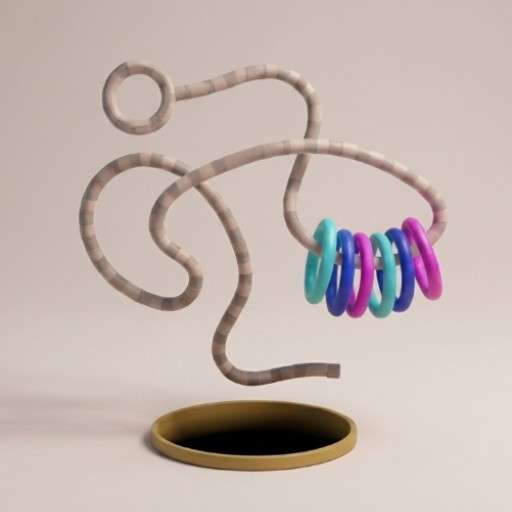


















What Exactly Is This Game?
Tangled Hook Twister is a physics puzzle that strips things down to the basics. You have a hook, a bunch of colorful rings, and a tangled wire maze. No buttons to press, no power-ups—just rotation and gravity. The idea is simple: twist the world so the rings slide along the wire and land where they need to go. But the execution? That’s where the challenge lives.
The game has a clean, almost minimalist look. The 3D perspective helps you see how the rings are positioned, but it can also trick your eyes. What looks like a clear path from one angle might be a dead end from another.
How Rotation Works (And Why It Matters)
You control everything by swiping (on mobile) or using the left and right arrow keys (on desktop). That’s it. There’s no speed control or reverse gear. The hook rotates in place, and gravity does the rest. Rings slide, drop, or get stuck depending on how you tilt the hook.

Here’s the thing: you’re not just rotating for fun. Every turn changes which way gravity pulls the rings. A ring resting on a wire segment might start rolling if you tilt enough. But tilt too fast, and it can slip off the wire entirely. That’s the core of the game—finding the right angle, then holding it long enough for the ring to travel where you want.
A Few Practical Tips for New Players
If you’re just starting, here’s what I’d keep in mind:
- Go slow. It’s tempting to spin the hook quickly to see what happens. But rings don’t respond well to sudden flips. Small, steady rotations work better.
- Watch the ring, not the hook. Your eyes will naturally follow the rotating hook. Instead, keep your focus on the ring you’re trying to move. See how it reacts to each degree of tilt.
- Use the wire loops as guides. Some sections of the maze are curved like ramps. If you tilt just right, rings will slide along those curves naturally. Let the geometry do the work.
- Don’t rush to clear all rings at once. Sometimes it’s smarter to move one ring to a safe spot, then reposition for the next one. Trying to move everything at the same time usually ends with a ring dropping into the void.
What Stands Out (And What Doesn’t)
After spending some time with Tangled Hook Twister, what struck me most is how much the game relies on patience. It’s not a reflex test. It’s a spatial reasoning puzzle where the solution is often just a few degrees of rotation away. That feels rewarding when you figure it out.
But I’ll be honest: it can get repetitive. The core mechanic doesn’t change much from level to level. You’re always rotating, always nudging rings along wires. The difficulty comes from more tangled mazes and tighter spaces, not from new mechanics. That might wear thin for some players after a while.
Who is this for, then? I’d say it works well if you enjoy puzzles that make you think in 3D—like those old marble maze games or those rotating-platform puzzles. It’s also good for short sessions. A single level doesn’t take long, so you can play a few rounds during a break and not feel stuck.
Common Mistakes to Avoid
New players tend to make the same few errors. Here’s what to watch for:
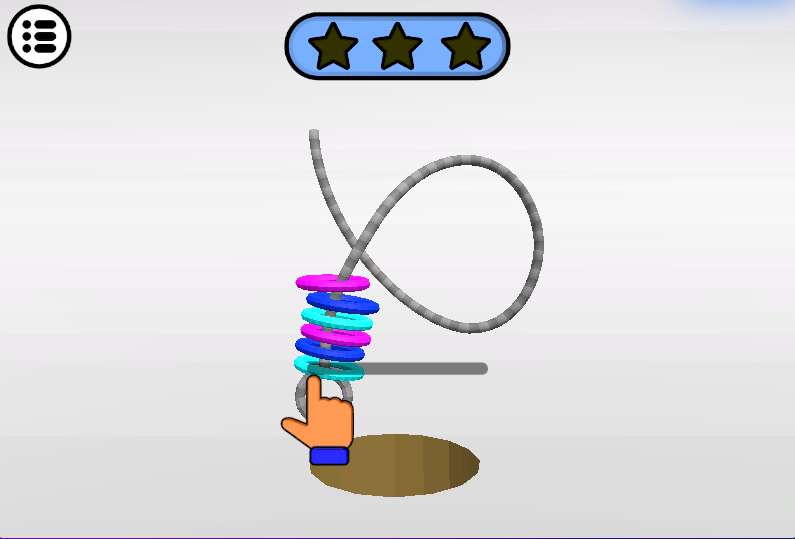
- Over-rotating. You turn the hook, the ring starts moving, and then you keep turning because you’re not sure when to stop. The ring flies off the wire. Stop as soon as the ring is moving where you want.
- Ignoring the second ring. Some levels have multiple rings. If you focus on one for too long, the others might slide off or get stuck behind a loop. Check on all of them periodically.
- Thinking every wire is a path. Some wire segments are just decorative or act as barriers. A ring can’t cross every wire—it has to follow the connected route. Pay attention to which wires actually lead somewhere.
Final Thoughts on Getting Better
The real skill in Tangled Hook Twister is learning to predict how gravity will behave after each turn. That comes from trial and error, not from reading tips. So don’t be afraid to fail a level a few times. Each attempt gives you a better sense of the maze’s layout and how the rings respond.
If you hit a frustrating level, step back and look at the whole maze before touching the hook. Sometimes the solution is obvious once you see the full path. Other times, you just need to find the one angle that lets gravity do the heavy lifting.