


















What’s Going On Here?
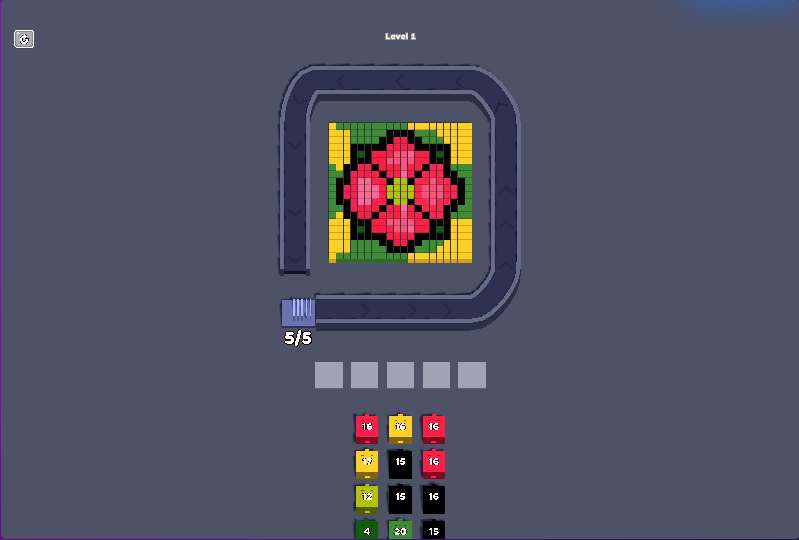
Color Pixel Flow looks simple at first. You’ve got a conveyor belt, some numbered pigs, and a wall of colored cubes waiting to be smashed. The pigs are your little demolition crew. Each pig has a number above its head — that’s its ammo, or how many hits it can deliver before it disappears. Tap a pig to put it on the belt, and it rolls toward the cubes, automatically targeting the ones matching its color.
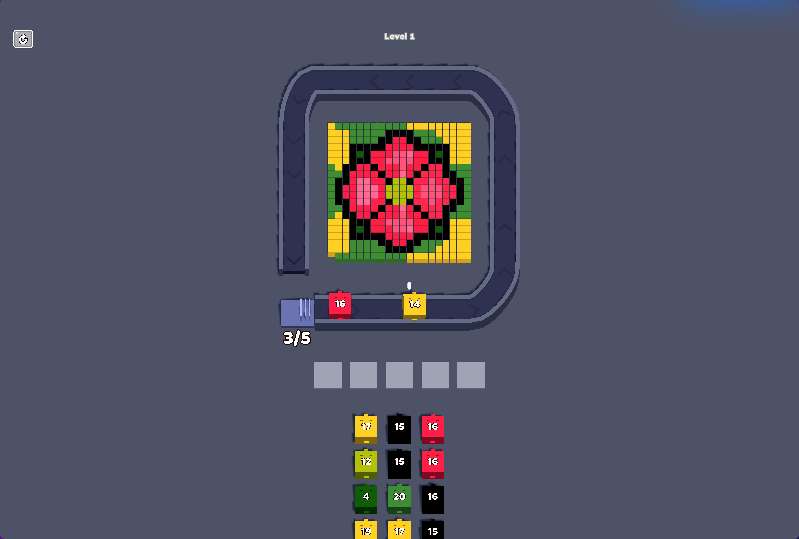
But it’s not just about tapping mindlessly. The conveyor has limited space. Send too many pigs at once and they bunch up, blocking new ones from being placed. You’ll end up waiting, and those cubes won’t break themselves.
The Pig Flow: Ammo, Slots, and Timing
When a pig runs out of ammo, it leaves the stage. But if it still has hits left after its run, it hops into one of five waiting slots at the bottom of the screen. That’s important — those slots let you reuse a pig without putting a fresh one on the belt. Tapping a waiting pig redeploys it immediately.
Here’s the trick: you only have five slots. If all are full and you send another pig with leftover ammo, it’s gone for good. So you need to decide which pigs to reuse and which to let go. Sometimes it’s better to waste a pig with one ammo left than to clog up a slot that could hold a pig with three or four hits.
Common Mistake: Overloading the Conveyor
The biggest thing new players mess up is sending pigs too fast. The conveyor belt moves at a steady pace, and each pig takes a few seconds to reach the cubes. If you queue up six pigs in a row, the last ones just sit there waiting while the first ones do their job. Meanwhile, you can’t place new pigs because the belt is full.
Better approach: send one or two pigs at a time, watch them hit, then decide what to do next. The game doesn’t punish you for waiting — there’s no timer. Use that breathing room to plan your next move.
Color Matching and Priority
Pigs only target cubes of the same color. If you have a row of red cubes but only blue pigs available, you’re stuck. That’s where the waiting slots help — you can keep a blue pig ready while you work on clearing reds with whatever red pigs you have.
Sometimes the cubes are stacked in a way that forces a specific order. You might need to clear a few green cubes before a hidden yellow one becomes reachable. Keep an eye on the whole board, not just the front row. It’s easy to tunnel-vision on what’s immediately in front.
When Repetition Kicks In
Let’s be honest: Color Pixel Flow is a simple loop. Tap, launch, clear, repeat. After a dozen levels, the core mechanic doesn’t change. That’s fine for short sessions — perfect for killing five minutes while waiting for something — but don’t expect deep strategic layers. The challenge comes from managing the conveyor and slot limits, not from complex puzzles.
It works best if you treat it like a casual rhythm game. You’re not solving a brain-buster; you’re finding a comfortable cadence. If you like games where you can zone out a bit but still feel clever when things click, this one fits.
Quick Tips for New Players
- Don’t fill the conveyor all at once. Two pigs at a time is usually enough.
- Check the waiting slots often. A pig with 3 ammo is better than a fresh pig with 1.
- Let pigs with 1 ammo expire if your slots are full. They’re not worth keeping.
- If you’re stuck, look for cubes of a color you have multiple pigs for. Clear those first to free up the board.
- There’s no penalty for pausing. Take a second to look at the cube layout before sending anything.